
Distant Viewing, the application of computer vision methods to Humanities data in the spirit of Distant Reading, is a well established part of Computational Humanities. But is it a scam?!
Before you get mad, please note that this is a deliberately provocative title meant to get you to read this blog post (gotcha). And no, I don’t actually think distant viewing is a scam. But there is something to it. I think that will become clearer what I mean once I share my experience. What I want to say is that the reality of distant viewing is not as straightforward as it might appear when looking at a handful of successful flagship projects that seem to demonstrate how well this approach works.
If you’re wondering what the heck distant viewing is, I had at some point prepared a blog post to help with that but it seems I never published it (but I still might…).
My experiences distant viewing humanities data
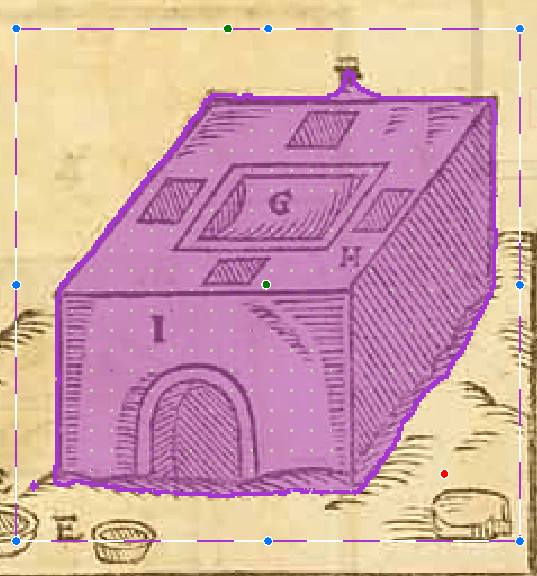
In my research, I set out to apply computer vision techniques to the visual culture of early modern alchemy, focusing in particular on laboratory objects. The idea was to develop this as one chapter within a larger monograph. Very quickly, though, the practical challenges became obvious. This kind of project is interdisciplinary and technically demanding, and trying to carry it out without dedicated funding or proper infrastructure pushes against the limits of what a single researcher can realistically do, especially when the computational work is only one part of a broader study.
The project began during what could, in retrospect, be called the “ChatGPT revolution” of 2023. There was a strong sense at the time that computational methods were about to become readily usable “out of the box,” driven by the excitement around generative AI. In reality, that optimism was somewhat ahead of the actual technological situation. Still, influenced by that atmosphere, I started experimenting with off-the-shelf computer vision tools, supported by colleagues whose expertise made those early steps possible.
It didn’t take long to run into problems. Object detection algorithms had to be trained to recognise unfamiliar, highly domain-specific visual features. While these tools can look impressive in demos, they struggled with early modern alchemical images—not because the algorithms are inherently weak, but because these images differ fundamentally from the kinds of data the models are trained on.
This becomes clearer when you compare them to the data in projects working with 19th-century photographs or more modern visual material. These are the famous projects we all know and likely associate with the term distant viewing or visual/multimodal turn in DH. Those images tend to produce much better results than using computer vision algorithms on my alchemy data, which is not all that surprising once you think about it carefully.
Their images are closer to contemporary photographs and contain objects like people, animals, or everyday items that are well represented in widely used modern datasets. From a technical perspective, identifying a person or a cat in a Victorian photograph is a very different task from detecting an alchemical distillation apparatus in a 17th-century woodcut.
Interestingly, the issue was not primarily one of visual style. Bridging the gap between early modern prints and modern images turned out not to be the main obstacle. The real problem was conceptual: the objects I was interested in simply do not exist in the datasets these models rely on. Contemporary computer vision systems are built around surprisingly narrow and culturally specific categories. If your material aligns with those categories, things can work reasonably well. If it does not, the algorithms struggle.
This is where the limitations of distant viewing start to show. These methods depend heavily on the data they are trained on, and that data reflects particular historical and cultural contexts. When the model encounters something unfamiliar, it tends to fall back on categories it already “knows.” So an elongated object might be labelled a “baseball bat,” even when that makes no sense in the context of early modern alchemy. This is not really a failure of the model, it is a reflection of the biases built into the dataset.
These kinds of biases have been widely discussed, especially in relation to issues like race and gender, but they also become very visible when working with historical material that sits far outside contemporary visual culture. In that sense, distant viewing works best when the material is already close to the world the algorithms were trained on.
The Alchemy of Annotation and Data Work
One of the most unexpectedly fundamental aspects of my project was the amount of manual annotation involved. There is a tendency to overlook this kind of data work, even though it has a huge influence on the results. Annotation is not just a preliminary step, it is a core part of the research process. Going through hundreds of images forced me to engage closely with the material and to reflect on how categories are defined. In fact, one key insight emerged not from the computational analysis itself, but from this manual work: the naming of alchemical apparatus often depends more on function than on visual form. In case you want to read more about that, I wrote a data paper about it. And a few blogposts on here: Fine-tuning Machine Learning with Humanities Data: Creating Ground Truth Annotations (i.e. Labeled Data) and How to create your own fine-tuning or training dataset for computer vision using Supervisely.
(As for the title of this section, as an alchemy researcher I want to alert you to the fact that making “the alchemy of X” puns in talks or section headings is only ok when I do it. I will be mad if other people use ‘alchemy’ in this absolutely infurating way.)
Despite its importance, this kind of data work often remains invisible. Publication formats tend to prioritise the description of algorithms while giving little space to the complex, iterative processes behind data preparation. Even within my own project, it became difficult to reconstruct all the small decisions that had shaped the dataset in the first iteration of the project. Much of this labour remained undocumented.
I have a lot to say about the importance of such data work to computational approaches. In fact, this blogpost may or may not be an ad for my recent article on the topic, which you may check out in case you want to know more: Lang, Sarah A. “(Doing) Computational History: The Role of Data Work in Computational Approaches.” Histories 6, no. 2 (2026): 26. https://doi.org/10.3390/histories6020026
In any case, this whole conundrum has broader consequences. Without detailed documentation, it becomes harder for others to understand, evaluate, or reuse the data. It also reinforces a divide between computational work, which is highly valued, and the “merely digital” work of data curation and annotation, which is frequently sidelined. Ignoring how much data quality shapes outcomes makes that divide possible but it comes at a cost to the quality and transparency of research.
So, all in all, do I think distant viewing is a scam? Not really.
But it’s not as simple as one might initially expect it to be, and it’s important to know what one is getting oneself into.
That’s it for now and thanks for all the fish!
Buy me coffee!
If my content has helped you, donate 3€ to buy me coffee. Thanks a lot, I appreciate it!
€3.00

 LaTeX Ninja'ing and the Digital Humanities