
Dear all, apparently the LaTeX Noob is not alone to be a noob 😉 I just realized I had to approve your comments before they are published. Oops 😉 Will see to that more quickly in the future. Also, I heard that some of you were not able to find contact information which maybe I might have messed up too 😉 I guess I just hadn’t really thought about having actual readers who want to contact me so far. And I am very happy that you exist and do wish to contact me! I will therefore add my contact info in the about section. Sorry, I am such a complete idiot not to have thought about this before 😉 Best and thanks again for all your positive feedback!
Short Post
Category informative of the fact that a certain post is rather shorter than my usual lenghty posts, which probably makes it about the length of what a post should be :)
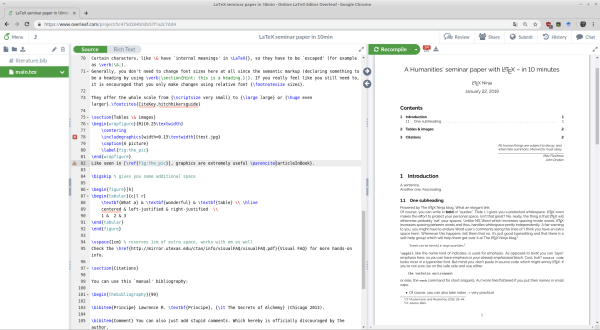
A Humanities’ seminar paper with LaTeX – in 10 minutes
Don’t believe me when I claim you could write a whole seminar paper in 10 minutes? I wouldn’t either 😉
read more A Humanities’ seminar paper with LaTeX – in 10 minutes
The power of simplicity, or: How to use tutorials
This is just a quick post, telling you to use tutorials selectively. If you don’t have time, don’t burden yourself with the not-so-short intro to LaTeX or 30 min introductions. Jumpstart in 3 minutes and go. This morning, I realized one thing: depending on what you want to do with LaTeX, you only need a very limited amount of commands. Even I use a very limited amout of commands for everyday tasks. Going through a whole tutorial might actually be a waste of time for you. You only need 3-5 go-to commands What you always need (and, for example, an Overleaf blank document already supplies): You will typically need the general document setup (minimal example), \newpage, \maketitle, \tableofcontents, and \sections and \emph{}. For teaching documents, I will additionally need \textbf{boldface}, enumerate and itemize environments. Then maybe \href{http://latex-ninja.com}{links} (\usepackage{hyperref}), \texttt{typeface} for code or the verbatim environment. And, of course, I often use my cheatsheet template. For writing scientific articles, I
Learn programming from a book vs. tutorial? Thoughts on deliberate practice
In this short little post, I want to share some thoughts on deliberate practice and how it affects coding, learning how to program, etc. I will argue that, in the long run, you can only become a better programmer with some systematic (self-)education, be it from books or academic classes. Tutorials alone, on the other hand, get you actionable quickly but do this at the expense of providing “the bigger picture” which will ultimately harm and slow down your progress. The concept of deliberate practice I have been intrigued by the concept of ‘deliberate practice’ for a few years now. It mostly comes up in the context of the so-called 10.000h rule (popularized by Malcolm Gladwell’s The tipping point – which is full of blatantly false information by the way and has been debunked by Steven Pinker, see Resources). Deliberate practice is needed for expertise and reaching a level of mastery. If you just want the ‘quick fix’, don’t bother
read more Learn programming from a book vs. tutorial? Thoughts on deliberate practice
Why most “learn programming” classes, books and attempts fail
This seems to be a bold claim. Let me explain… There are two reasons why I think most introductory programming classes fail ant that is a) because they never actually teach prorgramming (i.e. “algorithmic thinking”, not the syntax of one concrete language / “your first language”)) and b) because they bombard students with tons of complicated subjects which are not necessary at the beginning, so nobody remembers or understands them anyway. But they confuse the students and distract them from what they really should learn like how to interact with the machine and basic flow control. Use a visual language (like Scratch for PC or Catrobat for mobile devices) and thank me later. Algorithmic thinking When we want to learn or teach how to program, we first need to define what programming is. Like in a human language, knowing the words and the grammar is not enough – knowing a language means “knowing how to communicate using that language”. For
read more Why most “learn programming” classes, books and attempts fail
 LaTeX Ninja'ing and the Digital Humanities