
Fancy Headers and final Footers in LaTeX
This post explains advanced uses of headers and footers. The template changes between two fancy pagestyles and provides a TikZ based header and a

Tutorials, code, or rants concerning LaTeX
This post explains advanced uses of headers and footers. The template changes between two fancy pagestyles and provides a TikZ based header and a
Inspired by the learn x in y minutes tutorials, here comes my contribution to starting LaTeX quickly. If you want to jumpstart learning LaTeX, open your Overleaf account (or get one, they just require your email, no other info, takes 30 seconds) and open a blank or example project. A blank project will give you the following output: You can now start typing text. Wherever you want, but for now, preferably below \section{Introduction} and in between \begin{document} and \end{document}. The stuff before is the settings which don’t interest you just yet. There you can see fields for title and author which \maketitle uses to make a title. This is what you can use to generate a title page later on. Now type a sentence below \section{Introduction}, then hit space twice. Write another test sentence. Hit space twice and write \subsection{test}. To see your changes, you need to ‘compile’ this source code into an output PDF. Do this in Overleaf by
In today’s tutorial I will show how to reproduce a beautiful example of historical print using XeLaTeX. The inspiration for
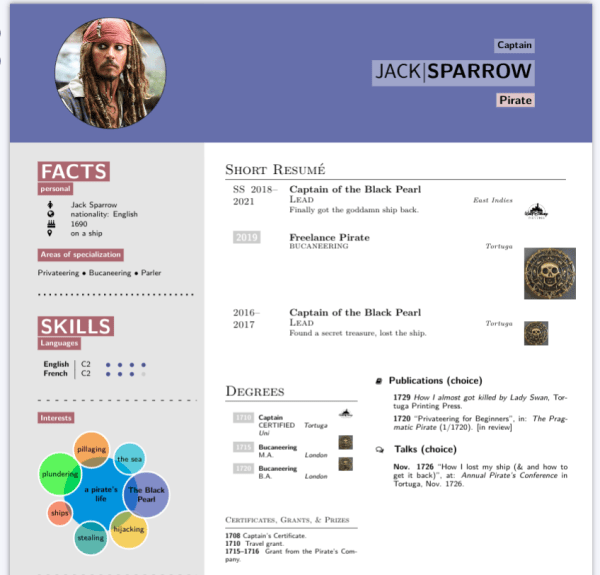
Working on a cool resumé template for you guys 😉 Always open for your suggestions and feedback. So far, I
In this post, I want to address the question of how to pronounce “LaTeX”. And explain to you, why this question cannot be answered if you want to take the investigation seriously. It turns out to be a classical Humanities’ style thinking kind of logical dilemma. Unlike other explanations, I dont’ want to provide an answer (because there isn’t one) but rather explain why this question is not just a matter of “knowing how it’s pronounced” and thereby, show why we need the Humanities. Description of the current situation There are multiple pronounciations currently in use which are all considered to be more or less valid. But it can sometimes come to holy wars if you refuse to adopt the accepted pronounciation at large in your social or work environment. This is why I want to prove in this article that the question of how to pronounce “LaTeX” is actually a logical dilemma we can’t solve. I thus invite everyone
read more The Name of the Game: How to pronounce LaTeX correctly (once and for all – or not)
Dear friends, today I would like to talk to you about one very serious topic: becoming a good LaTeX user. I say this as someone who definitely had to go through a painful conversion process. I now shall confess my sins: I used to ignore LaTeX errors when they didn’t seem to affect the output (meaning there would be PDF output, no fatal error stopping LaTeX from compiling, plus maybe no overly visible problems). I shudder to confess it now but: Nonstopmode was my best friend. To spare you, my friends, from following me down this path of vice and misery, I want to bring up the subject of good LaTeX conduct today. Read error messages, then ACT ON THEM At least try to figure out what’s going on. If you make this a habit, you will not only learn a lot and actively get better at LaTeX with all the (hopefully not totally fruitless) online research you’ll be doing.

 LaTeX Ninja'ing and the Digital Humanities