
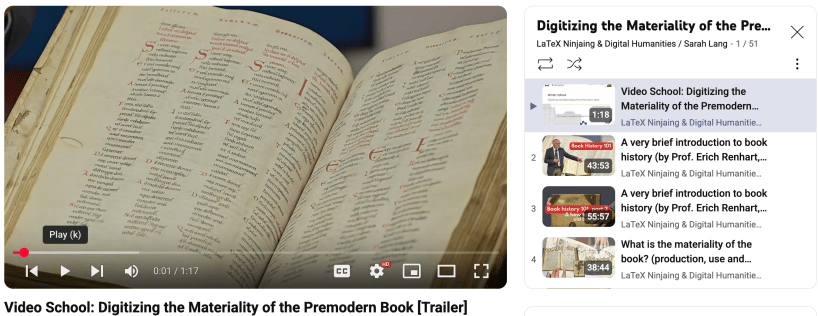
If you didn’t get into Rare Book School, you’re not alone—and you’re definitely not out of options. Whether you’re just starting out with rare books, trying to get a handle on bibliographical description, or diving into the digital side of scholarship, our video school Digitizing the Materiality of the Pre-Modern Book was designed to give you the essentials. These short, accessible videos are tailored for students, researchers, and anyone working with (rare) books or digitization projects. Best of all, they’re free—because we believe this kind of knowledge should be open to everyone.
Apart from introductions to basic book history, bibliography, bibliographical description, we also teach the basics of digital humanities and digital scholarly editing. The videos are designed to give you enough information to teach yourself—particularly useful if you need to get up to speed quickly, such as for your PhD thesis. This video school was created as a free alternative to Rare Book School, focusing on the core content we think everyone should have access to—because we believe education should be free.
For further reading, you might want to look into these blog posts: What do we mean by ‘materiality’ in the context of rare book digitization? & What do we mean by ‘materiality’ in the context of rare book digitization?. To find any other related posts, you may also want to look into the relevant tag.
A bit of context about Rare Book School
To be clear, this is not intended as a rant. Rare Book School offers well-regarded, prestigious classes that are valuable for many and look good on a CV. But they’re also prohibitively expensive and competitive to get into, which makes them inaccessible to most. Education should be free, and that’s my main issue with them.
To give you some context, I’m not exactly a disgruntled customer, but I did have some disappointing experiences with Rare Book School. I once had funding for one class but wasn’t accepted into my top choice (introductory bibliography). I ended up taking an online course in digital humanities that didn’t quite meet my expectations, despite the high cost—around a thousand euros. I believe the in-person classes might be stronger, but my experience left me feeling that high-quality instruction in these areas shouldn’t require that level of financial investment. I’m strongly opposed to the American principle of using students as cash cows: In the U.S., students often have to pay significant amounts to get an education or to attend prestigious schools that look good on their CVs. This financial burden usually forces them into debt, which I find unacceptable.
Imagine my surprise when, after paying a thousand euros for an online class, which I found only okay, I kept receiving emails from Rare Book School asking for donations. It felt tone-deaf to be asked for more money after already paying so much—especially knowing that many students are working with limited budgets and most of them will not be in a financial position to donate.
Formal qualifications can matter, but remember that meaningful learning doesn’t always require expensive programs. If you’re looking for something affordable, consider that most European countries offer free or low-cost higher education—including excellent digital humanities programs—if you can get a visa.
So while Rare Book School remains a prestigious option for professional development (if you can get in), I felt there was an immediate need for accessible, high-quality education in these areas. This frustration motivated me to create a free alternative. Partnering with some colleagues, we developed our own school to provide some essential knowledge on RBS topics without the high costs.
Our course is different in many ways from typical RBS courses and offers only three short intros compared to the week-long programs. However, it provides the crucial knowledge needed to get started and guides you on where to learn more.
Conclusion
If you’re a student or researcher who needs to learn basic skills in book history, bibliographical description, book digitization, or digital scholarly editing—quickly and without cost—we hope this resource helps you. Maybe if you’re a more traditionally minded scholar, it will get you interested in digital humanities as well.
Our video school offers introductions to:
- Book History
- Descriptive Bibliography
- Rare Book Digitization
- Digital Humanities (including a crash course intro to digital scholarly editing with TEI/XML)
These topics are relevant to anyone working with books or rare book digitization. Our videos provide enough information to teach yourself if you need to get going quickly, such as for your PhD thesis.
We know how hard it can be to access specialized knowledge when courses are expensive or slots are limited. That’s why we made these videos—to offer a practical, approachable starting point for anyone curious about book history, bibliography, or digital humanities. We hope this helps you get started, sharpen your skills, or simply discover something new.
If you have questions or suggestions for topics you’d like to see covered, feel free to get in touch. I teach a lot of classes and have a range of materials—some of which I’m slowly turning into blog posts. If there’s a specific topic you’re looking for, just ask—I might already have a handout, or I can invite a colleague to contribute a guest post.(And keep an eye on this blog.)
Thanks for reading and good luck on your journey into the world of (rare) books and digitization!
Best,
the Ninja
Buy me coffee!
If my content has helped you, donate 3€ to buy me coffee. Thanks a lot, I appreciate it!
€3.00

 LaTeX Ninja'ing and the Digital Humanities
One thought on “Didn’t get into Rare Book School? This is what you can do instead”