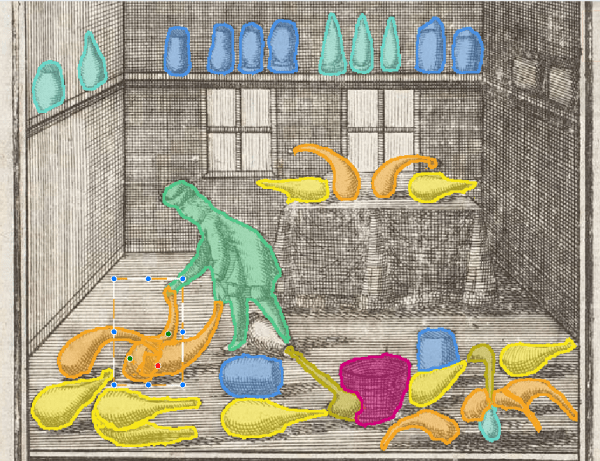
How to create your own fine-tuning or training dataset for computer vision using Supervisely
In an earlier post, I described the considerations that go into creating a training dataset for Computer Vision, including how

Tutorials, code, or rants concerning LaTeX
In an earlier post, I described the considerations that go into creating a training dataset for Computer Vision, including how
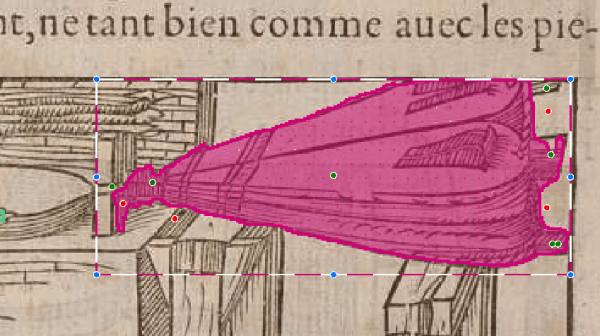
Today’s blog post is a teaser for a video class called Computer Vision for Digital Humanities (funded by CLARIAH-AT with
read more How to create a ground truth data set for computer vision using Humanities data
During the annual conference of the DHd Association, the Empowerment Working Group organized a workshop on the topic of Data Feminism in the Digital Humanities (organized by Luise Borek, Nora Probst & Sarah Lang, technical support: Yael Lämmerhirt)[1]. This short blog post aims to present preliminary results to document the event and raise awareness for this essential topic. Everyone is invited to participate in the project and should contact the Empowerment Working Group if interested. Citation suggestion: Luise Borek*, Elena Suárez Cronauer, Pauline Junginger, Sarah Lang, Karoline Lemke & Nora Probst, Data Feminism as a Challenge for Digital Humanities? [English version], in LaTeX Ninja Blog, 01.07.2023. https://latex-ninja.com/2023/07/01/data-feminism-as-a-challenge-for-digital-humanities/ *All authors contributed equally. Disclaimer: This is a machine-translated version of the original German article (found here), powered by ChatGPT 4. I read over it to make sure there’s nothing wildly inappropriate in there but since terms used are crucial when it comes to this topic, the German version is the one we
read more Data Feminism as a Challenge for Digital Humanities?
Today’s post is a short introduction to digital scholarly editing. I will explain some basic principles (so mostly theory) and point you to a few resources you will need to get started in a more practical fashion. I’m teaching a class on digital scholarly editing this term, so I thought I could use the opportunity to write an intro post on this important topic. How does a Digital Edition relate to an analogue scholarly edition? Unlike analogue scholarly editons, digital editions are not exclusive to text and they overcome the limitations of print by following what we call a digital paradigm rather than an analogue one. This means that a digital edition cannot be given in print without loss of content or functionality. A retrodigitized edition (an existing analogue edition which is digitized and made available online), thus, isn’t enough to qualify as a digital edition because it follows the analogue paradigm. Ergo: It’s not about the storage medium. A
read more What you really need to know about Digital Scholarly Editing
Today’s post is my long-awaited take on typesetting scholarly editons using the reledmac package. Not only does it introduce the
read more Enough reledmac to be dangerous: Scholarly Editing with LaTeX & XSLT
It’s been awfully quiet on this blog but actually, there’s lots of Ninja activity going on right now: I’m excited to announce that I will give the first ever official LaTeX Ninja workshop, in person at Harvard in about two weeks! It’s called “Beyond TEI: Digital Editions with XPath and XSLT for the Web and in LaTeX”. (Apart from that, there’s a short book review coming up in TUGboat.) Since there probably are a good number of people who would be interested in such a workshop but can’t attend in person, I will share the slides and teaching materials on Github later on. That way, they can be reused for self-study. This blogpost gives somewhat of an outline of the contents of the workshop and contains links to related posts on this blog. Participants might want to read some of them in preparation or as an additional resource. [Get to the github repo with all the materials (`additional resources’ directory)
Because I’m a classicist by training, I have been wanting to broach the topic of how to typeset Ancient Greek in LaTeX for a long time. So today comes a short post on the topic. There are a number of ways you can approach this but most importantly, you need to decide whether you need just any Greek letters or Ancient Greek letters. Because Ancient Greek has diacritics which aren’t featured in all (“normal”) Greek keyboards. This blogpost covers the three sub-topics I deemed relevant to the question and they are: How do I get my Greek letters in the first place? (related to 1) How/Where do I get a Greek keyboard and which one to choose? How to typeset Greek in LaTeX? How to get your Greek letters If you’re just adding, say a note on the origin of a word to your text, you might not even need to install a Greek keyword at all. When I just
Conference paper submissions in LaTeX are becoming increasingly popular in fields outside the technical disciplines (which have embraced them a long time ago already). Be that the Digital Humanities or historians wanting to contribute to events such as HistoCrypt, LaTeX templates for submission are getting more widely adopted. That’s why I wanted to dedicate this first post of 2022 to this important topic, so you are ready for LaTeX conference paper/abstract submissions in 2022! How to get started quickly and what to be aware of Find the template to use. The conference will have probably prepared a template you’re supposed to do. Since a principle behind TeX/LaTeX is the separation of form and content, you really only need to focus on writing your text. The layout will be provided by the conference organizers in said template. If this template isn’t on Overleaf yet, download it and upload it as a new project in the online LaTeX editor Overleaf. This will
read more The LaTeX Newbie’s Guide to Using Overleaf for Conference Paper Submissions
Actually I wanted to write about something different today and had a post already prepared. But then I came across yet another instance of people making negative comments about LaTeX (for apparently no reason and without explaining why they think so) and I guess that made me angry, so here’s today’s post about today’s topic: Why is it so normalized to make snarky side comments about LaTeX? Both in the DH community and otherwise. What is people’s problem with LaTeX? So the offending post, in this case, was this – but I really don’t mean to shit on it because it’s a great post otherwise (I have actually written something similar in Where can I *actually learn* programming? (as DH and otherwise). I guess that’s part of the reason why it makes me so angry. It’s an overall great post by people who are influential in the DH, with a considerable audience and otherwise doing great work. And then a
read more Why is it so normalized to make snarky side comments about LaTeX?
It’s Halloween and while for me, this is a holiday which usually pretty much passed me by unnoticed, I know that many of you probably care and celebrate. So I thought: What topics in Academia or academic writing especially are spooky? The honest anwer is probably: Way too many. But one stood out in particular and that’s the dreaded part of the writing process which lends itself to procrastination like no other: The literature review and excerpting process. Without it, not a lot of writing can happen (except maybe if you start working on a case study or use our Article Outline Template to sharpen your argument). So anyway, I thought this counts as a sufficiently scary activity for Halloween 😉 Info: I think I might end up not having proper code formatting in this post. Sorry for the inconvenience but it seems that the backtick on my keyboard is broken and WordPress has long since removed the keyboard shortcut
read more Preparing your literature review and excerpting: My workflow in LaTeX
Many prospective LaTeX users wonder: How do I get started? How to find my way in the jungle that learning LaTeX often seems to be to a first time user? Today I wanted to share my review of Stefan Kottwitz, LaTeX. A Beginner’s Guide (Packt 2021) with you. This book can help you find your way and get started using LaTeX after just the first chapter. Acknowledgement: I was sent a free reviewer’s copy of this book and asked to write a review about it which I happily agreed to do. Disclaimer: My book review policy Probably related to my upbringing in Germany, I don’t think a review can call itself a proper/serious review if it doesn’t contain criticism. I’m aware this is relatively different from reviews in the American style (especially on the covers of books) to just praise the book and not mention any criticism – but sadly, this also is becoming the norm in many an academic
In the process of coming up with the archaeological catalogue from CSV solution which you all seem to have loved, I had a realization: There are some packages which are just ‘magic’ in that they can make your life so much easier in just an instant. That is, if you know about them. So I decided to come up with a top 5 which reflect my own preferences because, ultimately, this choice is pretty personal. I researched some blogposts and online resources as well as checking in with the Twitter #TeXLaTeX community. I summarized the results of this extensive search in the following post 😉 So why did I choose the topic of today’s post? I think the answer is very close to the overall purpose of this blog: There are lots of great resources on LaTeX on the internet, almost unlimited amounts of documentation – but how is a newbie supposed to know which information to read first or
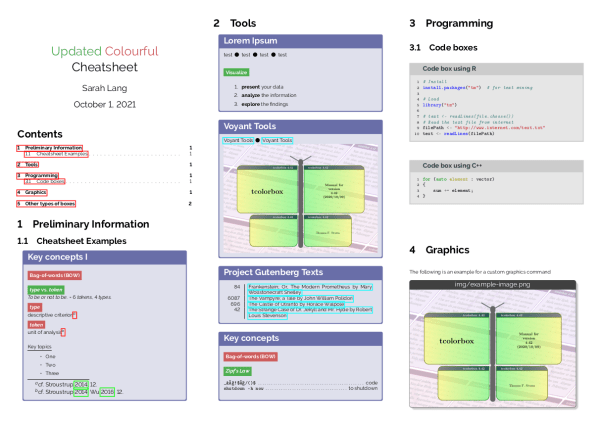
It has been a while since my last cheatsheet template. In the meantime, I have gotten a bit tired of
read more A new version of the Colourful Cheatsheet Template
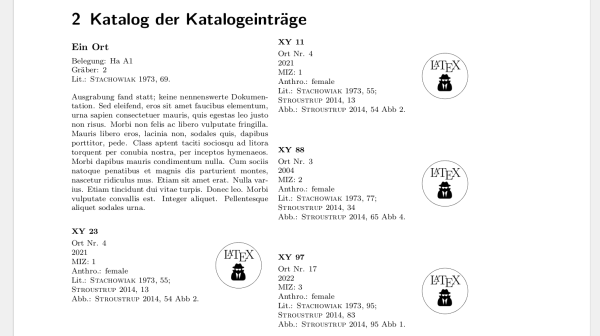
Today I wanted to share a long-promised second workflow for typesetting an archaeological catalogue in LaTeX. There is a first
read more LaTeX for Archaeologists: An archaeological catalogue from a spreadsheet
Today I wanted to share a tiny book review of the book I claim to be the most important book you should read if you want to learn any technical topic but are unsure if you are up for it. The book I’m talking about is not Donald Knuth (although his books are highly recommended, especially if you’re a (La)TeX nerd!). It’s not even a computer book! I’m talking about: Mindset: The New Psychology of Success by Carol Dweck (New York: Random House 2006). The fixed mindset versus the growth mindset This will be a short post because Dweck’s message is simple. There are two mindsets, the ‘fixed mindset’ and the ‘growth mindset’ and which one you have greatly impacts your success in learning and self-development. The ‘fixed mindset’ assumes your abilities and talents are fixed. Thus, you are proud of what you’re good at because you link it to your personality (“I’m a person who is good at…”). But
Having re-read my LaTeX for PhD students post, I realized I hadn’t mentioned a lot of things I would like to impart to you. So here comes LaTeX for thesis writing – a few more arguments in favour of starting to learn LaTeX now. Just to sum up what has already been said in the last post: The main points speaking in favour of you typesetting your thesis in LaTeX are the citation management, tables, maths and images which can be more of a hastle in MS Word. In the aforementioned blogpost, I also added that you should take into account that a thesis will yield two PDF outputs with very different requirements from the same document – another reason to use LaTeX. But there are many more things to take into account. LaTeX for maths, images and the like (in short, everything MS Word isn’t good at) A lot of people say that the “LaTeX is great for maths”
After a long hiatus, I’m back today with a post on how to develop the debugging skill. If you’re new to programming, we refer to the process of finding and solving errors in the code as “debugging”. It can be difficult to acquire this skill as a newbie when you have no idea what you should even look for. This post will help you out with a few hints. Why should I learn debugging? Most people who attend a programming class for the first time get quite the culture shock. Often, their identity had encompassed something like “good with computers”. Then they see what it’s actually like to interact with a computer as a superuser, i.e. someone who interacts with the computer not only in the way intended for users by product designers, i.e. mostly the Graphical User Interface (GUI). Often computer usage the superuser way means it’s entirely text-based (although you can learn the first steps to programming with
Today I wanted to address a common issue I see in troubleshooting LaTeX errors, on StackOverflow and in personal questions. It usually stems from newbies who aren’t yet aware of all the functionality provided by standard packages and thus, try to reinvent the wheel when something doesn’t work the way they expect. Why reinventing the wheel is a problem In my experience, even from me helping people with packages that I’m not all that familiar with myself, it’s always best not to reinvent the wheel (even if you succeed, the result is likely sub-par unless you’re actually really good at what you’re doing). Ask yourself if the functionality you want is something that’s likely to be a common problem. Then maybe somebody has already solved it in a comprehensive way! That’s what packages are for and that’s why they’re (hopefully) maintained by people who have given the problem at hand a good bit of thought. It is very likely that
Since some common objections why some people think learning LaTeX is not worth it or why the oppose LaTeX generally came up again in the Twitter discussion surrounding the recent post LaTeX for Philosophers? Logic and other Shenannigans, I quickly wanted to discuss the three most common objections agains LaTeX (in my experience) and why I think they’re not necessarily valid. Let’s get straight to it! 1) The “I can’t both be a good [insert job title/area of expertise here] AND spend time learning to code” aka the “LaTeX is hard to learn” objection A common argument used against LaTeX, not only in the Humanities, is “I already need all my energy being good at my job and now you want me to learn a new technology to distract me from it?”, like expressed in the following Tweet. But it’s really an extremely common one. The argument is interesting to me because you also had to learn how to use
Today, I wanted to share LaTeX resources for philosophers with you in a short post. I was included in a Twitter discussion yesterday about whether there wasn’t a post like that and I remembered there was – because a fairly long time ago I had been planning to write a post like that myself and already had a draft lying around in the depths of my WordPress account. So this is it, a short review of resources regarding the question: Should philosophers use LaTeX and what resources are there? Personal backstory which is totally irrelevant to the actual post: Funnily enough, one of my degrees is actually a Master’s degree in Philosophy, so you could say I know the field. However, I would think of my time at the Philosophy department more like a “field trip”, so to say. (Uh-oh, today is one of those bad-pun days.) I felt like getting to know the field to broaden my horizon or
read more LaTeX for Philosophers? Logic and other Shenannigans

 LaTeX Ninja'ing and the Digital Humanities